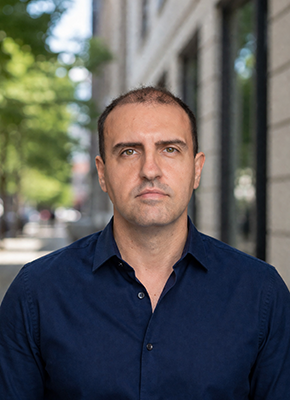
Blagoy Rangelov

Blagoy Rangelov

Associate Professor · Department of Physics · Texas State University

I am an Associate Professor in the Department of Physics at Texas State University. I study X-ray source populations in nearby galaxies — neutron stars, black holes, and the X-ray binaries they inhabit — using Chandra, the Hubble Space Telescope, and other observatories. My work combines multi-wavelength imaging, archival surveys, and machine-learning methods to classify and characterize compact-object populations. I also lead the Texas State Space Lab and am exploring AI-driven approaches to scientific discovery.

I am looking for motivated undergraduate and graduate students interested in X-ray astronomy, data science, or space instrumentation. Please get in touch if interested.


News

[Apr 2026] New paper published: Ahmed, Dutta & Rangelov, “Unsupervised Telemetry Anomaly Detection for CubeSats,” IEEE SouthEast Con 2026. DOI
[Apr 2026] New paper published: Guerrero & Rangelov, “Spatial Correlation of X-Ray Sources and Star Clusters in M31,” RNAAS. ADS
[Apr 2026] UNP Mission Concept awarded — serving as Co-PI.
[Nov 2025] New preprint: Rodríguez, Reisenegger, González-Caniulef, Petrovich, Pavlov, Guillot, Kargaltsev & Rangelov, “Neutron star heating vs. HST observations.” arXiv
[Sep 2025] PI on NASA Minority University Research and Education Project (MUREP) MPLAN award.
[Feb 2025] New paper published: Marentes & Rangelov, “Investigating the Nature of X-Ray Sources in the Andromeda Galaxy Using Chandra and Hubble Data,” RNAAS. ADS

Research

Pillar I

X-ray Astrophysics

Building automated, machine-learning classification pipelines for X-ray sources in nearby galaxies (M33, M31) using Chandra and HST. Studying pulsar bow shocks, unidentified Galactic GeV/TeV sources, and the connection between X-ray binaries and the young star clusters in which they form.

Automated classification Pulsar bow shocks XRBs & clusters Chandra / HST
Learn more
Pillar II

Space Exploration

Leading the Space Lab at Texas State — an experimental program where students design CubeSat payloads, build balloon-borne instruments, and work with vacuum systems for space-qualified hardware.

CubeSats Balloon missions Student lab
Visit Space Lab site
Pillar III

AI-Driven Discovery

Developing autonomous research agents that combine large language models with domain expertise to accelerate scientific hypothesis generation and literature synthesis.

AutoResearch LLM agents